.jpg "Bouillotte kettle \"Encounter on Albion\" (England, late 19th century)")
.jpg "Bouillotte kettle \"Encounter on Albion\" (England, late 19th century)")
.jpg "Bouillotte kettle \"Encounter on Albion\" (England, late 19th century)")
.jpg "Bouillotte kettle \"Encounter on Albion\" (England, late 19th century)")
.jpg "Bouillotte kettle \"Encounter on Albion\" (England, late 19th century)")
.jpg "Bouillotte kettle \"Encounter on Albion\" (England, late 19th century)")
.jpg "Bouillotte kettle \"Encounter on Albion\" (England, late 19th century)")
.jpg "Bouillotte kettle \"Encounter on Albion\" (England, late 19th century)")
.jpg "Bouillotte kettle \"Encounter on Albion\" (England, late 19th century)")
.jpg "Bouillotte kettle \"Encounter on Albion\" (England, late 19th century)")
.jpg "Bouillotte kettle \"Encounter on Albion\" (England, late 19th century)")
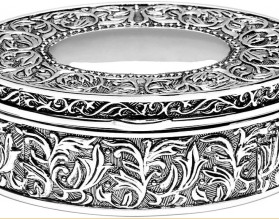
Bouillotte kettle "Encounter on Albion" (England, late 19th century)
Lot: 2137
England, end of 19th century, silverplated metal, hallmarks Cooper Brothers.
The bouillotte was made by English craftsmen using the technique of metal silver plating with ebony inserts.
The company of silver and silver-plated products was founded by brothers Thomas and John William Coopers in 1866 in Sheffield - one of the centers of silver production in Britain. Cooper Brothers had many stores and representative offices in cities and countries: London, Sydney, Melbourne, Montreal. Cooper Brothers worked until 1983.
A bouillotte, or a vessel for maintaining the temperature of water, came into fashion as early as the 18th century as the central decoration of the tea table. It was placed on a stand with a burner underneath. The difference between bouillotte was in a possibility to boil water (bouillotte couldn't do it).
English hallmarks on silverplated metal are very detailed.
Hallmark "EP" stands for Electro Plated and means a silverplated metal obtained by electroplating.
Letter "S" is used to represent the city of manufacture - Sheffield.
Hallmarks "C" and "Bros" are read together and belong to the manufacturer Cooper Brothers for the period 1866-1895.
General condition of the bouillotte is impeccable.
You can find additional and interesting information on this topic in the articles on our website (links below).
Weight 1,25 kg
Height 36 cm
https://www.925-1000.com/silverplate_C2.html
https://www.1stdibs.co.uk/furniture/decorative-objects/boxes/decorative-boxes/extraordinary-antique-english-sheffield-silverplate-cut-glass-oval-biscuit-box/id-f_23932102/
on the sign and add it to "Favorites"