
Fritz-Karl Watel/ François Vatel
.png) The 17th and early 18th centuries, as well as the reign of the famous Le Roi Solei, Louis XIV (1643-1715), can be called turning points in the history of French - and world - gastronomy. The atmosphere of luxury of that time left its mark on food habits: a 17th century meal is not a trite satisfaction of a basic human need, but a sacred rite. The dishes themselves have become more elegant and pretentious, cookbooks with dessert recipes have appeared, the table setting has changed. The key element of the new "philosophy" of food consumption was the arrangement of dishes and the whole system of their alternation and serving. The "pathfinder" of these changes was François Vatel - the cult chef, quartermaster, maître d'hôtel and steward of the most powerful personatilies of those times.
The 17th and early 18th centuries, as well as the reign of the famous Le Roi Solei, Louis XIV (1643-1715), can be called turning points in the history of French - and world - gastronomy. The atmosphere of luxury of that time left its mark on food habits: a 17th century meal is not a trite satisfaction of a basic human need, but a sacred rite. The dishes themselves have become more elegant and pretentious, cookbooks with dessert recipes have appeared, the table setting has changed. The key element of the new "philosophy" of food consumption was the arrangement of dishes and the whole system of their alternation and serving. The "pathfinder" of these changes was François Vatel - the cult chef, quartermaster, maître d'hôtel and steward of the most powerful personatilies of those times.
Nee Fritz-Karl Watel was born on June 14, 1631 in Switzerland, in roofer's family. The boy chose a different vocation for himself, and at the age of 8 he was given as an apprentice in a tavern to his godfather, the Parisian pastry chef Jeanne Everard. He started with distributing of sweet waffle rolls.
At the age of 22, in 1653, Fritz-Karl Watel worked in the castle Vaux-le-Vicomte for the powerful Marquis Nicolas Fouquet, superintendent of finance in the government of Giulio Mazarin. For 8 years Vatel from a simple kitchen worker had been growing to the manager of the entire castle: in his authority was not only the kitchen, but also all the auxiliary services and servants. The talented organizer was also a confidant of Superintendent Fouquet. This position helped him find useful contacts, enter high society and establish himself.
The position of Superintendent of Finance gave the Marquis Nicolas Fouquet the power to squander the royal treasury almost indefinitely. His Chateau Vaux-le-Vicomte was many times superior in luxury, pomp and beauty even to the royal court, which undoubtedly angered Le Roi Solei. As if that were not enough, the Marquis Fouquet took over the role of the main organizer of the festivities - the eternal privilege of the king! A feast on the occasion of the completion of the construction of the castle of Vaux-le-Vicomte put a final end to the already difficult relationship between Nicolas Fouquet and Louis XIV.
The banquet on August 17, 1661 was the "finest hour" of François Vatel, who was in charge of everything. The celebration was dedicated to the completion of the construction of the castle, which lasted for 15 years, so, it should have been truly impressive. The dinner consisted of 80 dishes in several shifts, the buffet - of 30. Many people were invited, including the King and Queen Mother Anne of Austria. Food was served on golden trays, an orchestra of 84 violins entertained the guests, and the court musician Jean-Baptiste Lully and the famous playwright Molière, also invited, staged a whole comedy-ballet as an entertainment. After supper, fireworks were awaiting the guests. The costs of all this action - not to mention the decoration of the castle itself - were many times higher than the cost of arranging the royal castle, which, of course, hurt Louis XIV. Obviously, the reconciliation did not take place ...
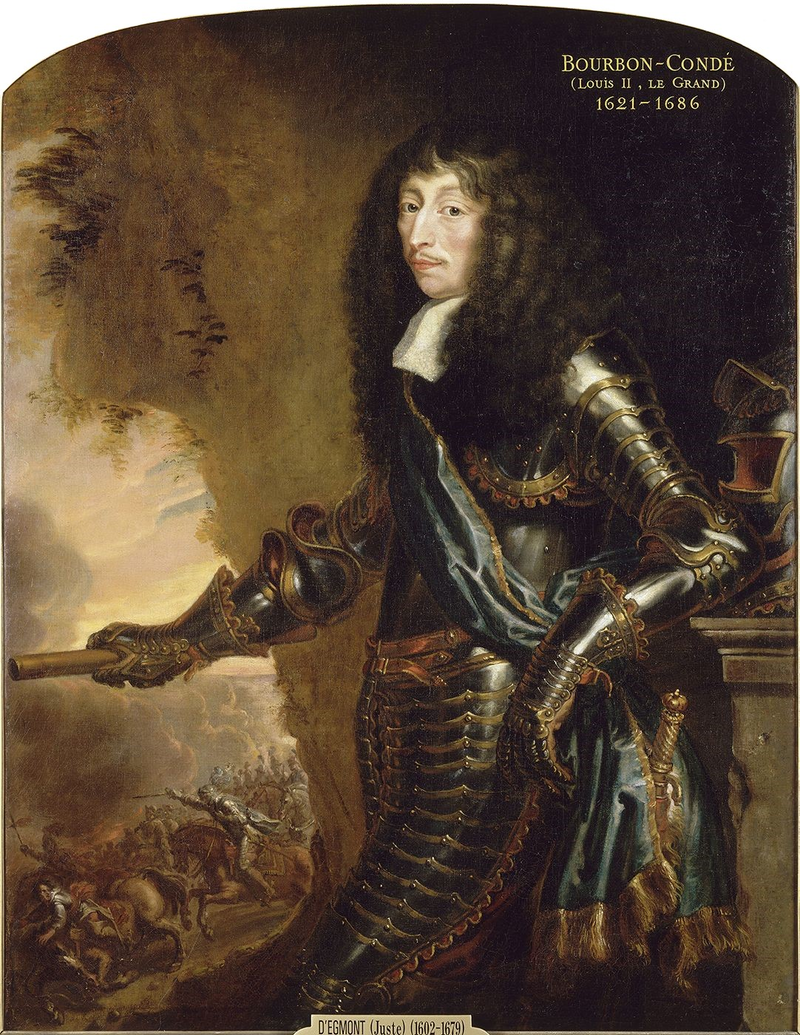
As a result, in 1661 Nicolas Fouquet was arrested and then convicted of embezzlement of public funds and a conspiracy against the king. François Vatel, a confidant of the Marquis, feared for his safety and fled to England. True, due to the general dislike of the British for the French and political tensions, he returned to France and got a job as treasurer of the stables at the Duke Gaston of Orleans. There he met Gourville, a confidant of Cardinal Mazarin and an old friend from his time with Nicolas Fouquet, who had fled to England with Vatel. Gourville helped his friend get to the stewards of the Chantilly castle to another representative of the royal dynasty - Prince Louis II de Bourbon-Condé. François Vatel stayed there from 1663 until his death. He was engaged not only in the kitchen, but also in all the services of the Château de Chantigny and other possessions of the Prince Conte - a mansion in Paris and the Château de Saint-Maur-de-Fosse.
Like Fouquet, Prince Louis II was also in the king's disfavor, but for another reason: during the anti-royal uprisings known as the Fronde, the Prince of Condé, a talented military leader, opposed the king. Only 8 years later, Louis XIV gave him a chance to whiten his reputation with military achievements. And, unlike Fouquet, the Prince of Condé was able to, and not only on the battlefield.
In April 1671, the king informed Louis II that, in recognition of Prince's military merits, he would honor and visit his Chantilly estate from 23 to 25 April. The prince instructed Vatel to organize a grand feast and leisure for 3 days in 15 days in order to "dazzle" the royal court and achieve the condescension of Louis XVI. François Vatel was well aware of the significance of this banquet for his employer ...
The servants, under the supervision and leadership of François Vatel, at a wild pace were engaged in the reorganizing of rooms to accommodate the king and his retinue, decorate the castle and the surrounding area with illuminations, and prepared fireworks. Vatel ordered new furniture and dishes, musicians, provisions, exquisite food and rare wines, thought out entertainment for the crowned guest. In responsibility of the great maître d'hôtel was the organization of three large breakfasts and at least four large main meals.
Moreover, a new type of meal was provided at the banquet - colacions. This is a type of light cold meals and desserts that are served in the afternoon or evening so that guests can have a snack during the ball or games. If the colacions were served in nature, then the tables were usually covered with food and furnished so that they fit into the landscape.
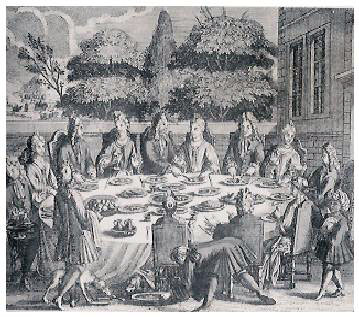
The first day of the celebration began with a royal hunt, after which the guests were invited to a grand 25-course dinner.
The members of the royal family were introduced to a new way of serving dishes - ambigu. It differed from the usual in two aspects: firstly, each guest had his own cutlery, and, secondly, all dishes - that is, cold, hot, salty and desserts - were served simultaneously, but are arranged on the table in a strict order.
Festive tables and serving amazed the guests: exquisite table setting, gold, silver, crystal, whole fruit compositions ...
Not without Vatel's next innovation: entre and entreme - small cold, salty or sweet snacks - between the main courses.
Despite the fact that later the reception will be successful and the desired result will be achieved, François Vatel will not be happy with the organization of the event. First of all, there were twice as many guests as planned - about 6,000 against 3,600, so the roast was not enough for everyone. True, there were already many other dishes there, so no one left hungry. Moreover, because of the bad weather, it was impossible to launch fireworks in the garden. Vatel, tired and overly nervous, at four o'clock in the morning made an inspection of the kitchen once again and agreed on the menu for breakfast and lunch on the second day. The second day, Friday, was "fast" when traditionally fish was served.
At 8 in the morning, he was overtaken by the terrible news: out of 4 carts with fish, only 2 arrived - and this despite the fact that fish were ordered from several fishing villages. This was the “last straw”: Fritz-Karl Vatel, or François Vatel, a man of the highest honor and pedantry, considered himself guilty in this unpleasant situation. The festive dinner could be spoiled because of him. He went to his room and stabbed himself with a sword ... and very soon the remaining carts with fish arrived.
The next 2 days of the holiday were flawless. François Vatel was buried quietly, and his duties passed to that very Gourville. Probably due to the circumstances of Vatel's death - and suicide is considered a grave sin in the Christian tradition - until the 19th century, he was not remembered. The "revival" of the name of the famous head waiter began with gastronomic reference books of that time - for example, Joseph Favre's "Universal Dictionary of Practical Cuisine" of 1883-1889.
Many of the achievements of modern culinary and service principles, up to catering, were introduced by Vatel: this is a buffet table, and the principles of serving and taking out dishes, and "dedication of dishes", that is, inventing certain names for them, and some recipes (for example, "cream Chantilly").
The name Karl-Fritz Vatel is still synonymous with the highest professionalism, dedication to work and a sign of quality!


