
Odiot
An iconic French company famous for its silver and gold products. The Odioе family has given the world lots of talented craftsmen.
It all began in 1690, when Jean-Baptiste-Gaspard Odiot was appointed purveyor of the royal court and became the personal silversmith of King Louis XV. However, one who brought real fame and worldwide recognition to the house was Jean-Baptiste-Claude.
.jpg)
The son of Jean-Claude Odiot and the grandson of mentioned Jean-Baptiste-Gaspard was born on June 8, 1763 in Paris. At the age of 16, he joined the dragoon regiment and rose to the rank of colonel-general.
In December 1785, Jean-Baptiste-Claude Odio received a certification as a silversmith and his own hallmark (the initials JBCO around the helmet, which after the Revolution were replaced by bellows). 42 years (from 1785 to 1827) he created many exquisite products for the most fastidious taste, giving preference to the Empire style and antique motifs. It is known that Odiot made a couple of goblets and coffee urn for Thomas Jefferson according to the sketches of the US 3rd President.
Jean-Baptiste-Claude Odiot was not only a talented silversmith, but also a brave warrior: in 1814, together with General Bon-Adrien Jeannot de Moncey, he participated in the defense of Paris at the Clichy outpost during the wars of Napoleonic France and the coalition of European countries. He was awarded Order of the Legion of Honor (Colonel-General Odiot even ordered from the famous artist Horace Vernet a painting that immortalized this event ("La Barrière de Clichy. Défense de Paris, le 30 mars 1814"), which can be seen today in the Louvre).
The relationship between Jean-Baptiste-Claude Odiot and the Emperor Napoleon Bonaparte and his family is very interesting. Despite the fact that Odio was not officially appointed as purveyor to the emperor (which played into the hands of the silver house during the Restoration) after the bankruptcy in 1809 of the previous one, Henri Auguste, Odiot made many products for him, his family and those close to him.
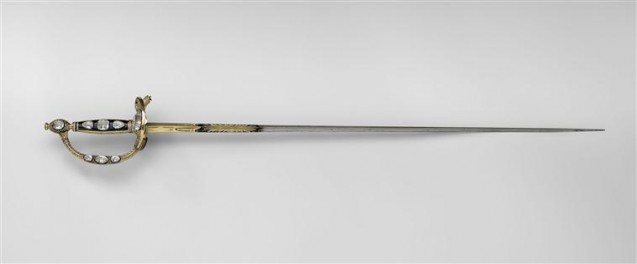
The first order came in October 1801: together with the jeweler Marie-Étienne Nitot, Odiot made the consular sword of Napoleon. In 1802, the sword was awarded a gold medal at the World Fair 1802.
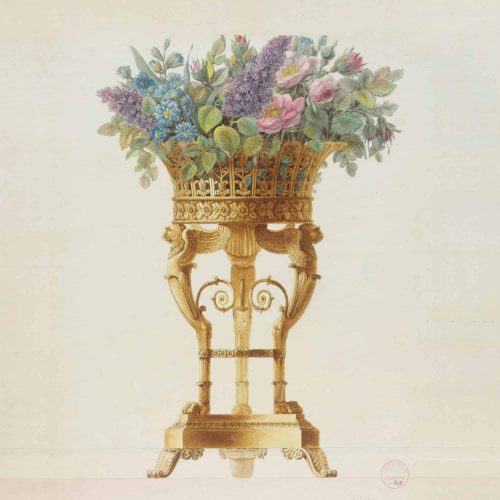
In 1806, Jean-Baptiste-Claude Odiot took triumphal part again at the World Fair, this time with a silver gilded tripod in the antique style. In the same year, the emperor's mother, Letizia Bonaparte, ordered from the master a large tableware made of gilded silver, which was fully completed in 1808.
In 1810, commissioned by the prefect of the Seine department in Paris, Nicolas Froсhaut, Jean-Baptiste-Claude Odiot, together with the French sculptor and caster Pierre-Philippe Thomire, had a boudoir made of gilded silver and lapis lazuli according to the drawings of the artist Pierre-Paul Prudhon. This is a gift for Marie-Louise of Austria on the occasion of her marriage to Napoleon Bonaparte.

A year later, the imperial couple received a gift from the city of Paris “The Cradle of the King of Rome” (Berceau du roi de Rome) on the occasion of the birth of the heir, Napoleon II. The cradle was also created by Odio and Thomir from Prudon's designs.
After the fall of Bonaparte and during the Restoration, the House of Odiot not only did not lose its rich clientele, but also began to receive orders from kings and aristocrats from all over Europe: First Duke of Wellington Arthur Wesley, Austrian diplomat and Prince Clemens Metternich, King of Prussia Friedrich Wilhelm III, King of Württemberg William I and Prince Regent of England George IV.
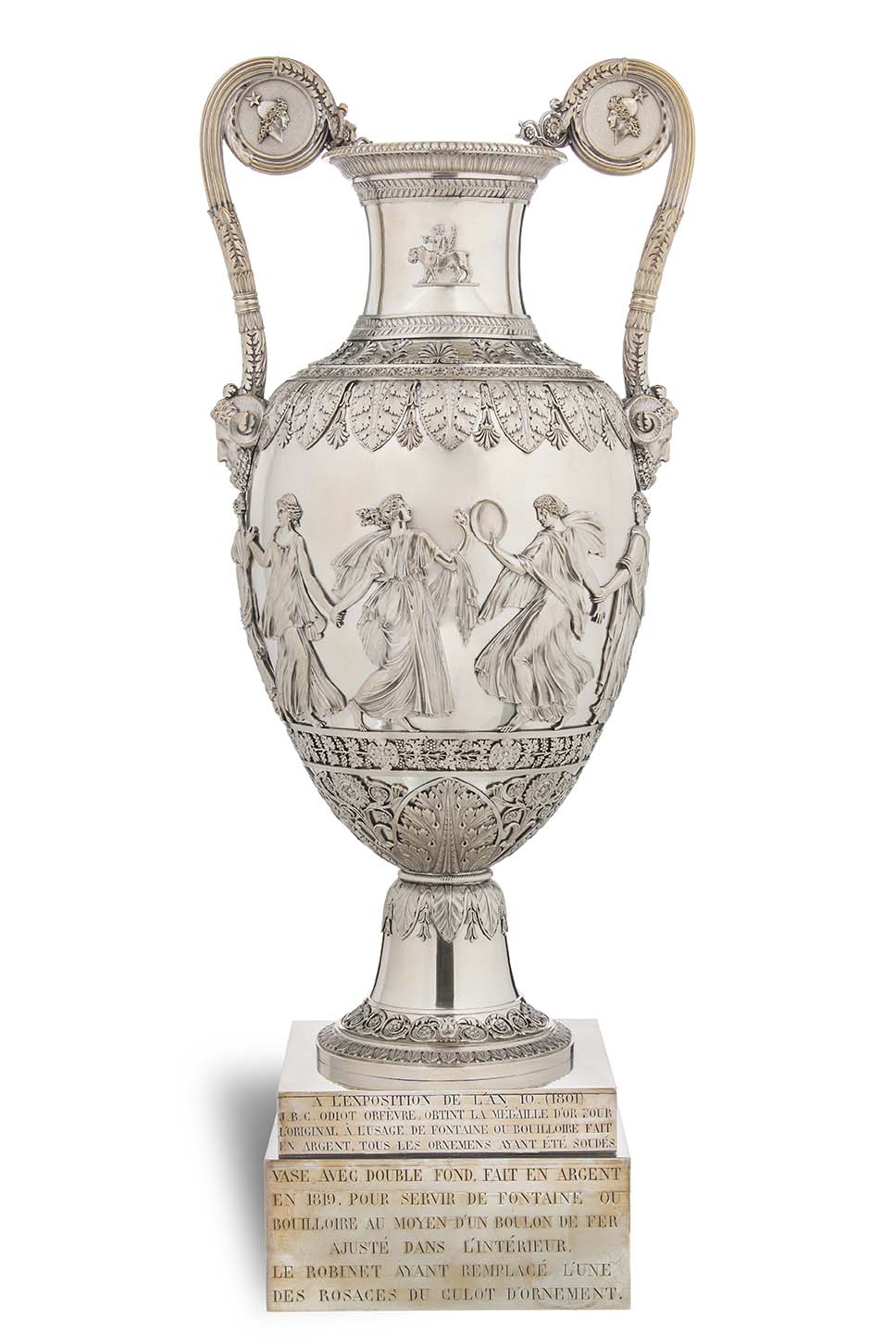 Jean-Baptiste-Claude Odio takes part again in two World Exhibitions - in 1819 and 1823.
Also, from 1819 to 1835, the master donates part of his works to the government of France: for example, thirty bronze objects and a silver vase end up in the Luxembourg Palace (more precisely, its wing, set aside for a museum). At the end of the century, the collection was transferred to the Museum of Decorative Arts. In 1907-1908. another famous jeweler, Christofle, has silver-plated Odiot state-donated bronzes.
In 1827, Jean-Baptiste-Claude retired (he died in 1850), handing over the business to his son, Charles-Nicolas Odio. He becomes the purveyor of the court of King Louis Philippe and his family.
The Odiot empire was succeeded in 1856 by Charles-Nicolas's son, Jean-Baptiste-Gustave. He became a supplier to the royal court of the Russian Empire under Alexander II, and also received the largest order in the history of the house: a table service for 3000 pieces of solid gold for Said Pasha, Viceroy of Egypt. It was Jean-Baptiste-Gustave who was the first to register the famous Odiot brand in 1864: the letter O and an old lamp.
Jean-Baptiste-Gustave Odio was the last of the glorious dynasty. Since he left no heirs, in 1894 he registered a new company - Odiot Prévost Récipon et Cie - which he runs together with Emile Prevost and Paul-Edouard Resipon. From 1906 to 1956 Odiot merges with another famous silver house, Boulenger. Since 1956, Odiot is again an independent company with the highest quality products, which still exists today.
One of the secrets of making cutlery is an alloy that has been tested for centuries: 925 sterling silver and a little copper for stiffening. The alloy is remelted into ingots, then rolled to the desired thickness and cut as blanks. Then the pattern is engraved, which is subsequently “honed” by hand. If the customer wished to be gilded, then a layer of 24 karat gold 5 microns thick is applied to the product.
Odiot products are distinguished by a very complex, multi-faceted and, nevertheless, light pattern. More complex and voluminous elements (angels, dolphins, branches, etc.) are made exclusively by hand. First, they are cast in shape, and then the carver gives them individuality: patterns, details and other elements ...


